14 December 2025, 13:00 - 16:00
Basecamp Theories with Munir Fasheh
Seminar on mujaawarah (collective learning),
moderated by Remove the Dot (Saja Amro & Wassila Abboud)
In collaboration with Remove the Dot and moezeum
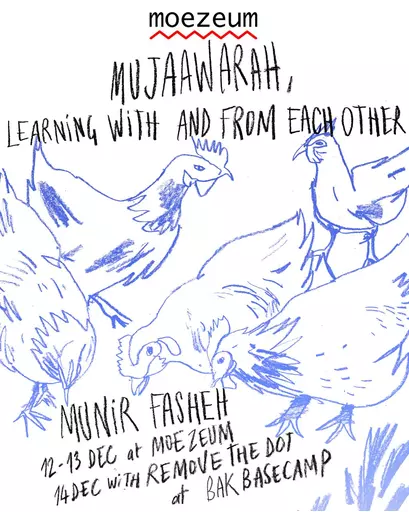
We are thrilled to host Munir Fasheh, as part of his first visit to The Netherlands, to discuss decolonial pedagogies and collective learning. Together with Munir, we will reflect on the foundations of his lifelong work on mujaawarah—learning through being together. As part of this knowledge exchange, Remove the Dot will also share research related to situated practices across Amsterdam, Palestine, and Lebanon. There will be time for exchange with fellow organizers and activists, and the chance to deepen your approaches to collective learning together.
This session is the second in our series Basecamp Theories, hosted by Remove the Dot and is in connection with OP=OP at moezeum. We have limited spots available, please register through this form! For your participation we ask for a donation between €8-20
Munir Fasheh
Munir Fasheh is a Palestinian educator, mathematician, and learning theorist known for his work on community‑based and decolonial approaches to education in Palestine and across the Arab world. Born in Jerusalem in 1941 and displaced with his family during the 1948 Nakba, he later pursued graduate studies in education, eventually earning a PhD in Education from Harvard University in the late 1980s.
Fasheh established Tamer Institute for Community Education, which revolved around protecting and providing “learning environments” through reading campaigns and neighborhood learning circles. His aim was to keep education alive outside closed schools and to root it in local culture and everyday life, building on what is beautiful, inspiring, healthy, and abundant in people, communities, and cultures, and making sense of one’s experience. A central concept in his work is mujaawarah, which refers to people learning together through companionship, conversation, and joint action in everyday life rather than through rigid classroom structures. Fasheh is widely recognized as a leading voice in decolonizing education in Palestine, advocating for approaches that value indigenous knowledge, community wisdom, and education as a form of cultural resistance and self‑determination.
Remove the Dot
Remove the Dot is an ongoing research program by Saja Amro and Wassila Abboud that takes guidance from historical and present voices at the forefront of the liberation struggle. Through both a materialist and speculative lense, Saja and Wassila explore the knowledge that emerges within contexts of oppression and rupture helping linger in spaces of imagination that provokes the gap between theory and political practice. The program is an experimental attempt to start from the consequences of institutional frameworks and their conditions of thought and knowledge production, while speculating on new frameworks beyond the arrangements of our time.
The work so far has evolved through various forms, including diagrams, public sessions, reading groups, and study days. The recent ongoing program explores relations to land and the commitment to sacrifice for it, requiring a rationality incomprehensible within institutional frameworks.
Saja Amro is an architect, educator, and designer based between The Netherlands and Palestine. Her work explores how spatial design shapes social dynamics in education and reimagines classroom structures through emancipatory pedagogy and collaborative practices.
Wassila Abboud is a cultural worker and writer researching between Amsterdam, The Netherlands and Beirut, Lebanon. With a background in Journalism, her work engages with critical theory, philosophy, and visual culture and takes on a speculative and materialist approach, examining the conditions of past and present historical struggles – particularly through the philosophical and theoretical works of Lebanese Marxist philosopher Mahdi Amel.
Basecamp Theories
Basecamp Theories is a new series of intensive studies grounded in the Basecamp’s ongoing unbuilding and rebuilding of cultural infrastructures. Each seminar invites a theorist with expertise in materially-grounded, emancipatory democratic practices and models of the past, present or future. Together, we will deep dive, close read and co-theorize around their proposed practices and models. This seminar series offers tactical imaginaries, shared strategies, and tools for resisting, so that we can go beyond simply being “anti-fascist” and begin to practice and build real alternatives.
